

There are two opposing views about wisdom teeth, or third molars. One is that they should be kept whenever possible; the other favours removal as they erupt, before potential problems arise.
Our task is to assess whether a wisdom tooth needs to be removed or can be preserved in the individual clinical situation.
Wisdom teeth usually erupt between the ages of 17 and 25.
What makes wisdom teeth different?
They erupt much later than the other teeth.
• Problems may begin during eruption, when the rest of the dental arch is already established and space is limited.
• Their position at the back of the mouth can make treatment more difficult and may require special instruments.
• Cleaning can be challenging, particularly when the tooth is tilted or partly erupted.
• Curved or complex root canals can make high-quality root canal treatment more difficult and increase the risk of complications.
When wisdom tooth removal may be considered
1) An unfavourable position.
A horizontally positioned tooth that cannot function within the dental arch may have little value for chewing or as part of a restoration.
Four principal positions of impacted wisdom teeth are described in the source material: vertical (48%), angled towards the tooth in front (26%), horizontal (17%) and angled away from the tooth in front (9%).
2) Insufficient room to erupt.
Lack of space can lead to difficult eruption and may complicate orthodontic treatment.
3) Damage to the second molar.
A wisdom tooth may affect the tooth immediately in front of it. Removal can be necessary to allow that neighbouring tooth to be treated and preserved.
A clinical example
A 22-year-old woman attended with acute pain in a lower left tooth. Her medical and family history did not reveal relevant systemic conditions.
Examination showed a fracture of tooth 3.7, the lower left second molar. A horizontally positioned wisdom tooth was in contact with it, and decay had developed in the contact area. This had contributed to the fracture.
The X-ray showed the crown of the wisdom tooth pressing against the second molar. In this case, the remaining structure of tooth 3.7 could not be saved and was removed.
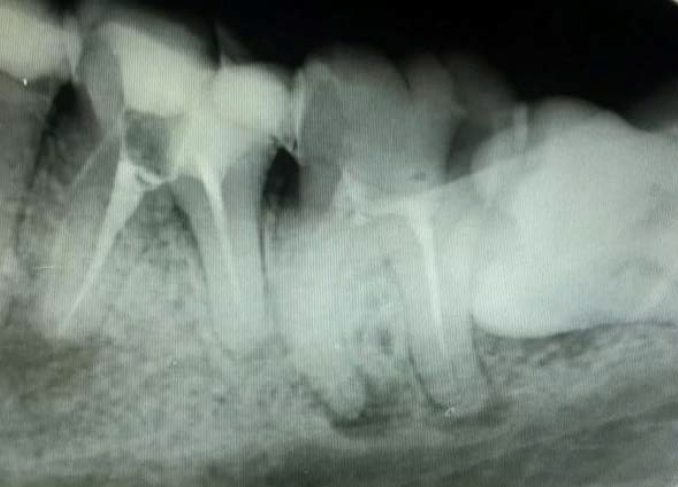
Clinical example: X-ray
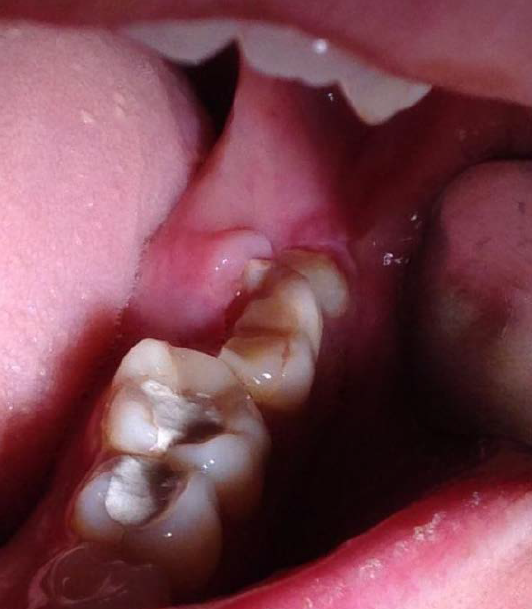
Clinical example
4) Pericoronitis — inflammation around a partly erupted tooth.
A space beneath the gum flap can trap bacteria, causing inflammation and swelling. Treatment may involve the gum flap, the wisdom tooth, or both, depending on the clinical findings.
5) Problems with the bite and jaw function.
A wisdom tooth outside the normal arch, particularly one without an opposing tooth, may create an unfavourable contact or overload in the bite.
The decision to remove a wisdom tooth depends on existing disease, complications and the assessed risk of future problems.
Why treatment of a wisdom tooth may be difficult
First, any filling or crown requires good daily cleaning, which can be harder at the back of the mouth.
Second, wisdom tooth roots and canals vary considerably in shape and position.
Third, limited visibility and access can make it difficult to use drills and longer root canal instruments effectively.
When a wisdom tooth may be worth preserving
1) It can contribute to a future restoration.
For example, the first or second molar may be missing, or a neighbouring tooth may be scheduled for extraction.
2) It has an opposing tooth and a useful position in the bite.
A correctly positioned wisdom tooth may contribute to chewing.
3) It can be treated predictably.
The tooth's position should allow access for complete treatment and a sound restoration.
Dentists can use small or angled handpieces, short instruments, good illumination and a rubber dam to improve access and isolation during treatment.
Key points
Wisdom teeth can be difficult to clean and treat because of their position and root anatomy.
Potential problems include:
• An unfavourable position or insufficient space.
• Damage to the second molar.
• Inflammation around a partly erupted tooth.
• Unhelpful contacts in the bite.
Preservation may be appropriate when the tooth:
• Is healthy or can be treated effectively.
• Has a useful position and an opposing tooth.
• Can be cleaned and maintained.
• Has value within the overall restorative treatment plan.
A clinical assessment helps determine the appropriate option for each tooth.


